
Too Old for What? We're More Interested in What You Still Have to Gain.
Nov 15, 2026
There's a funny thing that happens when you reach a "certain age." People start asking questions that sound suspiciously like you should be preparing to leave the building. Are you thinking about slowing down? Have you considered something a little easier on your body? Aren't you getting a little old for that?
Excuse me, I'm 54, not a carton of milk approaching its expiration date.
It got me thinking about the way we talk about aging women. She's still running marathons, still lifting weights, still wearing shorts, and still going on adventures. It's a fascinating little word, isn't it? As though every birthday comes with an increasingly short list of activities we're allowed to participate in.
A 25-year-old woman climbs a mountain, and she's adventurous. A 65-year-old woman climbs the same mountain, and suddenly she's "spry." Spry? She just climbed a damn mountain, Chad. Try athletic.
We've become so accustomed to expecting less from older women that watching one refuse to meet those expectations somehow feels extraordinary. But maybe she's not extraordinary. Maybe our expectations are embarrassingly low. And maybe it's time we raised them, because getting older shouldn't automatically give the world permission to lower the bar for what we're capable of doing.
You know what drives me batshit crazy? The remarkable amount of stuff women are sold to help us avoid looking like we've actually lived. Creams to erase the lines, serums to reverse the years, and procedures to convince everyone our faces have somehow escaped the passage of time. Meanwhile, nobody seems particularly interested in asking what we'd like our bodies to actually DO with all those extra years.
Personally, I'd like mine to keep carrying me up mountains, onto pickleball courts, through airports, and occasionally into situations that make my husband question his decision to marry me. I'd like to get off the floor without turning it into a three-act production, lift my own suitcase, play with my grandchildren, and try something new even if I'm absolutely terrible at it until I'm not.
I don't want to spend my sixties trying to look forty when I could be spending them building a body that lets me do whatever the hell I want at eighty.
And don't get me wrong, there's absolutely nothing wrong with wanting to look good. I want to look good, too. But I'd prefer to define what that means for myself rather than leave it up to some mediocre C-suite executive who thinks women half his age are genuinely interested in him for his personality.
There's a difference between wanting to feel good about your appearance and believing your value has an expiration date. And women have spent quite enough money confusing the two. We've been conditioned to celebrate looking younger while rarely being encouraged to celebrate becoming stronger, more capable, or more adventurous. Which is especially ridiculous when you consider that our future selves are going to need considerably more muscle than moisturizer.
Now, before this turns into a full-blown rant about the beauty industry, let's talk about something that actually deserves our attention: muscle. Beautiful, useful, metabolically active muscle. The stuff that helps you lift groceries, climb stairs, maintain balance, and continue doing things for yourself as you get older. Because while society has been busy telling women to fight wrinkles, researchers have been studying something considerably more important to our long-term independence: strength.
As we age, we become more vulnerable to losing muscle mass and physical function, a process that can contribute to something called sarcopenia. It's a real concern, particularly as we move into later adulthood, but it's not a reason to throw our hands up and surrender to the recliner.
In fact, here's the part that deserves a much bigger headline: getting older doesn't mean your muscles stop responding to exercise. Research consistently shows that older adults can improve strength through progressive resistance training, including people who begin later in life.
A 2009 Cochrane review found that progressive resistance training improved physical function and muscle strength in older adults. A 2019 position statement from the National Strength and Conditioning Association also reinforced the role of resistance training in supporting healthy aging. Translation? Your muscles haven't checked your birth certificate and decided they're done accepting applications.
You can still build strength, improve your capabilities, and make meaningful investments in the body you'll be living in decades from now. No, lifting weights won't guarantee you'll be doing cartwheels at 90. But it can help you build and preserve the physical capacity that makes an active, independent life more possible. Which, frankly, seems like a better return on investment than another $200 jar of hope.
And if you've never picked up a dumbbell before, congratulations. You've just discovered something new you can learn.
You Know What Else You Gain With Age? The Audacity.
At 25, I spent a ridiculous amount of energy wondering what other people thought about me. Was I attractive enough, successful enough, thin enough, or even momming correctly? As if there were a panel of judges somewhere holding up scorecards every time I made a decision. By my forties, I started realizing that most people were too busy worrying about their own lives to spend nearly as much time judging mine as I'd imagined. And the ones who were judging? Well, they weren't exactly people I wanted writing my life story.
Experience has a funny way of teaching you that other people's opinions aren't nearly as valuable as you once thought.
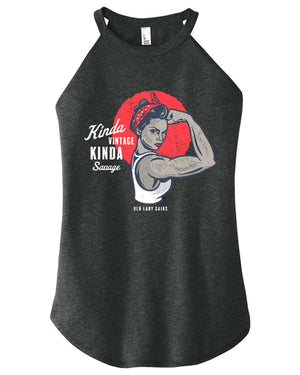
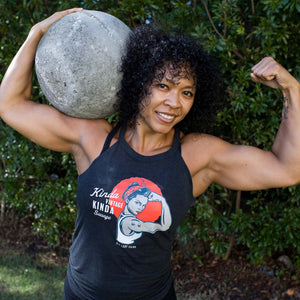
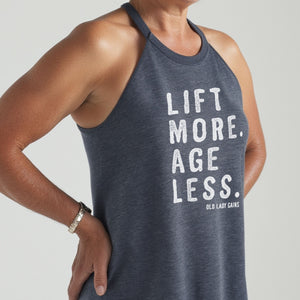
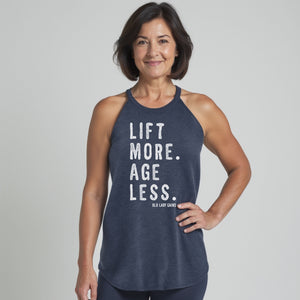
I started CrossFit at 42, and at 45, with absolutely no business education or entrepreneurial experience, I started Old Lady Gains. Not because I had some grand master plan, but because I saw women like me doing extraordinary things and couldn't find apparel that reflected who we were. The fitness world seemed perfectly comfortable celebrating young, strong women, while older women were apparently supposed to be delighted just to be included.
But I wasn't interested in being included as an exception. I wanted women over 40 to be seen for exactly what we were: athletes, beginners, competitors, adventurers, mothers, grandmothers, and women with muscles, ambition, opinions, and absolutely no intention of disappearing. So I made a couple of shirts, figuring there had to be a few other women out there who felt the same way.
Turns out, there were a whole lot more than a few. Women who were just as tired of being told what getting older was supposed to look like. Women who weren't interested in shrinking themselves to fit someone else's expectations.
Imagine that.
What If You Stopped Measuring Your Life by What You've Lost?
There's a strange habit we develop as we get older. We start comparing ourselves to earlier versions of ourselves: the body we had at 25, the energy we had at 30, and the face we had at 35. Somewhere in all that comparison, we forget to notice everything we've gained along the way.
Funny enough, the older I've gotten, the more confidence I've gained walking into a room without needing everyone to approve of me. I've gained the financial freedom to travel to places I've always wanted to see, the courage to walk away from relationships that were making me miserable, and the wisdom to recognize that being liked by everyone is a terrible life goal. And at 54, I'm still figuring out what I actually enjoy, which might be one of the best parts of getting older.
Because here's something nobody tells you when you're younger: you don't have to keep being the person you've always been just because you've spent decades being her.
Maybe you want to start lifting weights, learn to surf, go back to school, start a business, ride a motorcycle, run your first 5K, or travel somewhere that requires a passport and a questionable amount of courage. Maybe you want to fall in love again, wear the damn bikini, or finally stop apologizing for taking up space in your own life. All perfectly acceptable answers.
The point isn't that every woman needs to become a marathon-running entrepreneur who climbs mountains before breakfast. Good grief, some of us would just like to finish our coffee while it's still hot. The point is that you get to decide what a fulfilling life looks like at your age, and you're allowed to change your mind as many times as you damn well please.
So, What Do You Still Have to Gain?
That's the million-dollar question I'm asking here at Old Lady Gains. Not because I think aging is something to defeat, and certainly not because I believe every woman needs to spend her later decades proving herself to the world. I'm asking because women have spent far too long being told what they should expect to lose: their looks, their strength, their relevance, their independence, and their place in the conversation. And I'm interested in changing that conversation.
I want to make strong older women so ordinary that nobody bats an eye when an 80-year-old walks into the gym and loads a barbell. I want a 60-year-old woman trying something new to be treated like a person learning something new, not a medical miracle. I want women to stop looking at birthdays as deadlines for becoming someone and start seeing them as proof that there's still time to become someone else.
And I want the words old lady to stop sounding like an insult.
Because there are old ladies out there lifting heavy weights, starting businesses, setting records, falling in love, making mistakes, getting back up, and living lives that would make their younger selves proud. You don't have to look younger to have a remarkable future. You don't have to be fearless, and you don't even have to know exactly what you want next. You just have to stop assuming the best parts of your life are already behind you.
So here's to the wrinkles we've earned, the muscles we're building, the boundaries we're setting, the adventures we haven't taken, and the women we haven't become yet. Here's to getting older without automatically accepting that it means getting smaller. And here's to asking ourselves a different question every time the world reminds us of what we're supposedly losing.
The question isn't how much youth you have left. It's how much life you're still willing to live.
And if anyone thinks you're getting too old for that? Good luck with that, because we've still got shit to do.

Sources and Further Reading
-
Liu, C. J., & Latham, N. K. (2009). Progressive resistance strength training for improving physical function in older adults. Cochrane Database of Systematic Reviews. https://doi.org/10.1002/14651858.CD002759.pub2
-
Fragala, M. S., et al. (2019). Resistance Training for Older Adults: Position Statement From the National Strength and Conditioning Association. Journal of Strength and Conditioning Research. https://doi.org/10.1519/JSC.0000000000003230